Maine Dog Registration Information
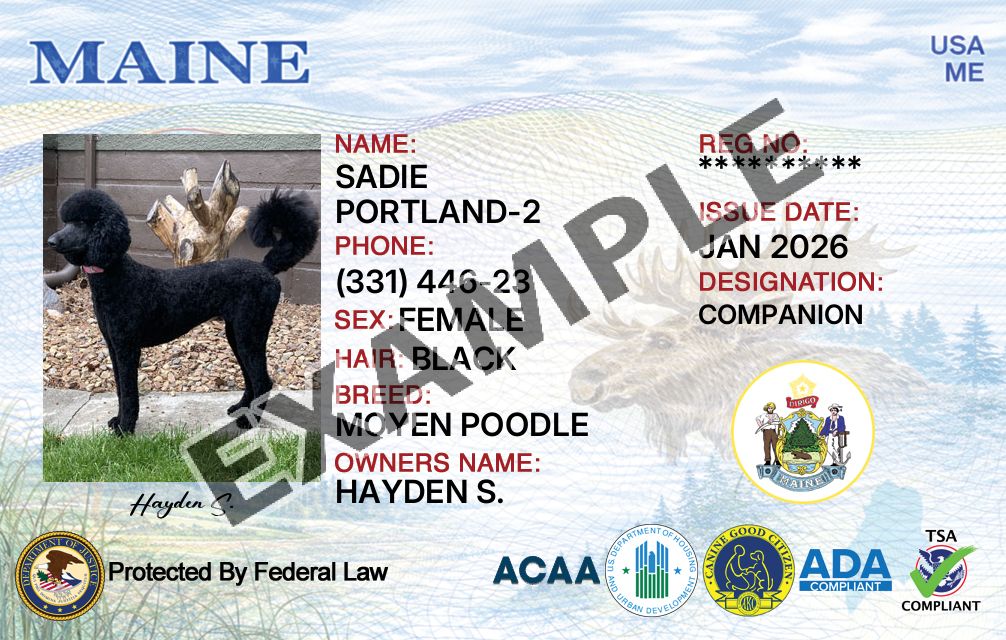
State Licensed, Service Dogs and Emotional Support Dogs in Maine
If you’re asking, “where do I register my dog in Maine for my service dog or emotional support dog?” the key thing to know is this: in Maine, you generally register (license) your dog through your local city/town office—not through a special statewide “service dog registry” or “ESA registry.”
A dog license in Maine is a local government license (usually issued by a municipal clerk or town clerk) that helps support local animal control and rabies compliance. A dog license is separate from whether a dog is legally a service dog or an emotional support animal (ESA). This page explains how animal control dog license Maine rules typically work, what rabies documentation you’ll need, and where to register a dog in Maine with examples of official offices.
Where to Register or License Your Dog in Maine
In Maine, dog licensing is typically completed through the city/town where the dog lives. Many residents start with the City Clerk or Town Clerk, and some communities also coordinate with Animal Control for enforcement and compliance. Below are several official example offices within Maine where residents commonly handle dog licensing. If your town is not listed, search your town’s official website for “City Clerk,” “Town Clerk,” or “Dog Licensing,” or call the main town/city number and ask where to license a dog.
City of Bangor — City Clerk & Treasury (Dog Licenses)
City of Lewiston — City Clerk’s Office (Dog Licenses)
City of Augusta — City Clerk (Dog Registration / Licensing)
Maine Department of Agriculture, Conservation & Forestry (DACF) — Animal Welfare (Dog Licensing)
Overview of Dog Licensing in Maine
What “dog licensing” means in Maine
A dog license in Maine is an official local registration that typically results in a tag number associated with your dog and your address. Licensing supports local animal welfare efforts such as animal control services, enforcement of animal welfare laws, and rabies compliance efforts. Maine’s state animal welfare program explains that dogs must be licensed in the town where the dog resides and that licensing helps support animal control officers and rabies vaccination compliance.
When you must license your dog
Maine’s statewide guidance commonly used by municipalities is that dogs must be licensed when they reach 6 months of age, and also after the dog has been with the family for a short period after adoption (commonly referenced as 10 days in municipal and state guidance). Licenses commonly expire at the end of the calendar year (December 31) and may be renewed for the following year, often with late fees after a set deadline.
Who enforces licensing and rabies compliance
You’ll often see enforcement and compliance tied to local Animal Control Officers (ACOs) and state humane/animal welfare agents, but the licensing transaction itself is usually processed through a municipal clerk or town office. That’s why searches like animal control dog license Maine can be confusing: animal control may enforce requirements, but the clerk’s office usually issues the license.
How Dog Licensing Works Locally in Maine
Step-by-step: where to register a dog in Maine (typical process)
- Find your local licensing office: Start with your Town/City Clerk (or Town Office). This is the most common answer to “where do I register my dog in Maine.”
- Bring required documents: Most towns require a current rabies vaccination certificate. Many also request proof of spay/neuter if you want the altered-dog fee.
- Pay the local fee: Many Maine communities follow common state-referenced fees (for example, some municipalities list $6 for altered and $11 for unaltered), but confirm with your town because local processing details can vary.
- Receive your tag/license record: You’ll usually receive a tag or confirmation. Keep your rabies certificate accessible in case it’s requested later by animal control or housing providers.
Online licensing (seasonal availability)
Some Maine residents can renew or obtain a license online through a state-supported online service during a defined seasonal window (commonly referenced by multiple Maine municipalities as October 15 through January 31). Outside that window, residents are typically directed to license in person at their local town/city office. If you missed the window, you can still license—just plan to do it locally and ask about potential late fees.
Rabies vaccination requirements (what the law says)
Maine law requires rabies vaccination for dogs. The statute provides that an owner/keeper must have a dog vaccinated against rabies within 30 days after the dog attains 3 months of age, and it also addresses certificates and booster timing consistent with recognized public health vaccination intervals. In practical terms for licensing: your clerk’s office will commonly ask for a rabies certificate showing the dog is currently vaccinated.
Service Dog Laws in Maine
What qualifies as a service dog in Maine (public places)
Maine law (through the Maine Human Rights Act definitions and related public accommodations provisions) describes a service animal as a dog that is individually trained to do work or perform tasks for the benefit of an individual with a disability, and the work/tasks must be directly related to the disability. Emotional comfort alone does not count as a task under that definition.
Do you “register” a service dog with the State of Maine?
In general, a dog becomes a service dog based on training and function, not because of a paid registry or an online certificate. For licensing purposes, a service dog is still a dog that lives in a Maine municipality—so the practical answer to where do I register my dog in Maine for my service dog is usually: license your dog with your town/city clerk like other residents, and then rely on service dog laws for access issues (not a “registration card”).
Service dog status vs. dog license in Maine
A dog license in Maine is a local licensing requirement. Service dog legal status is about disability accommodation rights in public accommodations and other settings under state and federal rules. These are separate concepts: your dog may need a license even if it is a service dog, and having a license tag does not automatically make a dog a service animal.
Emotional Support Animal Rules in Maine
ESAs are typically about housing accommodations
In Maine, guidance explaining the Maine Human Rights Act uses the term assistance animal in the housing context and explains that housing rules can require allowing certain animals as a reasonable accommodation for a disability. This is different from “public access” rules that apply to service dogs in public accommodations.
Does an ESA have public access rights like a service dog?
Generally, no. A dog that provides comfort but is not trained to perform disability-related tasks is usually not treated as a service dog for public accommodations access. If your primary concern is bringing an animal into public places, you should review service dog rules rather than assuming an ESA letter provides the same access.
ESA “registration” vs. local licensing
A common misconception is that you must “register” an emotional support animal with a company or buy paperwork. For Maine residents, the practical “registration” you typically need from government is still the local dog license (and compliance with rabies vaccination). The ESA-related documentation is usually relevant to housing accommodations, not to your city/town’s basic licensing requirement.
Frequently Asked Questions
In most cases, you register (license) your dog through the city/town where you live, typically at the City Clerk or Town Clerk office. This is true even if the dog is a service dog or an emotional support animal. Service dog and ESA concepts are separate from the local licensing requirement.
In Maine, the licensing transaction is most often handled locally by your city/town office (clerk). The state provides guidance and may support an online licensing service during a seasonal window, but residents are commonly directed to the town office for licensing—especially when online licensing is closed or if you need help with special cases.
Most municipalities require a current rabies vaccination certificate. Maine law requires dogs to be vaccinated against rabies within a set time after reaching 3 months of age and provides for a rabies vaccination certificate issued by a licensed veterinary professional or certified rabies vaccinator.
No. A dog license in Maine is a local registration/tag process. A service dog is defined by being a dog individually trained to perform disability-related work or tasks. A license tag can help identify your dog and show compliance with local rules, but it does not create service dog status.
Usually, yes. ESA status (typically relevant to housing accommodations) does not usually remove the basic requirement to follow local dog licensing and rabies vaccination rules. Confirm specifics with your town/city clerk.
Register A Dog In Other Maine Counties
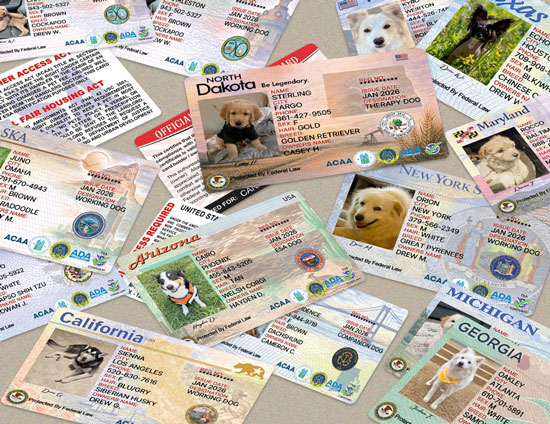
Select your county from the dropdown below to get started with your dog’s ID card. Requirements and license designs may vary by county, so choose your location to see the correct options and complete your pup’s registration.
- Androscoggin County Dog Registration
- Aroostook County Dog Registration
- Cumberland County Dog Registration
- Franklin County Dog Registration
- Hancock County Dog Registration
- Kennebec County Dog Registration
- Knox County Dog Registration
- Lincoln County Dog Registration
- Oxford County Dog Registration
- Penobscot County Dog Registration
- Piscataquis County Dog Registration
- Sagasahoc County Dog Registration
- Somerset County Dog Registration
- Waldo County Dog Registration
- Washington County Dog Registration
- York County Dog Registration